
Who's telling the truth about the cost of net zero?
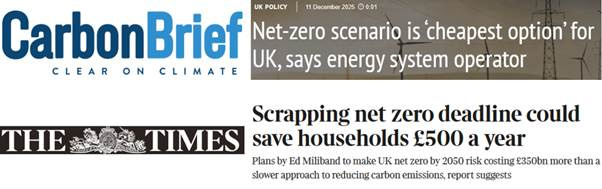
No wonder people are confused about whether achieving net zero carbon emissions will cost us more, or less. Just look at two headlines covering the same report published by the UK’s National Energy System Operator (NESO) yesterday.
The Times, a conservative-leaning newspaper, splashed its front page with a claim that “Scrapping [the UK’s] net zero deadline could save households £500 a year.”[i] Carbon Brief, a pro-environment media platform, titled their coverage with [the] “net-zero scenario is [the] ‘cheapest option’ for [the] UK, says [the] energy system operator”. These two publications have more in common than just avoiding “the” in their headlines. They are both misleading.
These and many other articles are referring to NESO’s analysis on Future Energy Scenarios (FES). NESO model four scenarios of energy costs between now and 2050. Most articles are comparing two scenarios: “Holistic Transition”, i.e. net zero or 100% emissions reduction by 2050, and “Falling Behind”, i.e. 50% emissions reduction between now and 2050. The first scenario is closest to the Labour government’s current energy policy. The second scenario is not “net zero” but still represents a large decarbonisation effort. This isn’t necessarily the policy that best represents anti-net zero political parties, but it’s the least ambitious of the scenarios included in NESO’s study.
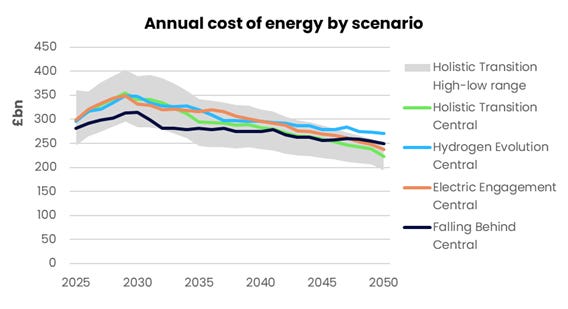
In all scenarios, energy costs go up in the short term and down in the long term. The Holistic Transition scenario starts at £299 billion per year, around 10% of GDP. Costs peak at £354 billion before falling to £222 billion by 2050, or 5 to 6% of GDP. Falling Behind is cheaper than Holistic Transition in every year until 2046.
Let’s revisit The Times’ claim of saving households money by scrapping the deadline for net zero. Although NESO caution against comparing scenarios because they contain assumptions unrelated to climate, NESO make it easy for the media to quote this anyway by presenting the cost difference between the Holistic Transition and Falling Behind scenarios. The Times are broadly right that hitting net zero by 2050 costs more than delaying action. The scenario which halves energy emissions is £14 billion cheaper per year on average between 2025 to 2050 than eliminating carbon emissions entirely. However, these savings would be unlikely to accrue to households alone. Businesses and the government share in energy costs too.
So why does Carbon Brief claim that NESO says that reaching net zero earlier is cheaper? Unlike the Times, Carbon Brief considers the implied cost of carbon emissions to be important, even if consumers wouldn’t necessarily see those costs on an energy bill or pay for them in cash. The Treasury values carbon emissions based on the marginal abatement cost of carbon to meet the government’s nationwide emissions targets. If these costs are included, the Holistic Transition scenario generates net benefits of £36 billion per year versus Falling Behind because it reduces carbon emissions.
This certainly makes it seem like the Times gets closer to the truth: that if NESO’s costings are correct, households and businesses will pay more for energy if the government works towards net zero by 2050 versus less ambitious targets.
This, however, ignores some important details. NESO changes some assumptions by scenario that aren’t related to climate, like data centre demand. £5 billion of the Holistic Transition costs in 2050 are due to estimating more than double the data centre demand than in the Falling Behind scenario. Put differently, this assumption suggests that delaying net zero would also diminish the roll-out of data centres, which the government considers a key pillar of economic growth.
The report also doesn’t consider the impact of achieving net zero on health, jobs, trade, and energy security. Cleaner air reduces deaths from pollution. Installing new energy technology generates significant jobs even if manufacturing is done elsewhere. European carbon border adjustments would affect British exports significantly if the UK stalls decarbonisation. Renewable energy investment reduces dependence on imported gas.
What’s striking is how confusing all this energy cost reporting is for voters. Reports that net zero is cheaper are hard to believe when monthly energy bills keep going up, even if they accurately reflect the non-cash cost of climate change. If the government can’t deliver real cost savings, they need to do a better job of selling the dream. Energy costs might go down in the long run, but the government doesn’t have a long run before they face voters at the next election.
[i] A previous version of the headline stated “net zero plan to cost households £500 a year”
Net zero is a scientific concept which has been extrapolated into the economic realm. So both sides of that argumaent are blatantly wrong for misinterpreting the context of net zero.